Delivery gates
Use verification that can reveal a meaningful failure in the change. Repository requirements remain authoritative. A docs edit may need links and a build; a behavior change needs checks for that behavior; a UI change may need browser verification. Repeat checks for relevant changes, failures, or unresolved concerns.
One review and CI owner
When a CE workflow is selected, it owns review settlement, feedback resolution, CI, and the watch loop. Use ce-commit-push-pr for PR creation and user-requested commits pushed to an existing PR. Railyard preserves the requested completion boundary and checks the returned evidence without adding a second watcher.
Unresolved feedback and stale checks must be handled before an authorized merge. A local check passing does not settle a PR, and a green PR does not establish post-merge or deployment success.
Specialist review
Before every push, satisfy the whole-candidate review gate. Cover the exact candidate’s complete cumulative change and affected lifecycle, including repair and release pushes. Collect completed reports, resolve actionable findings, and bind the reviews, checks, coverage and dispositions in a compact receipt before CE publishes.
Thermos runs two lenses against that same complete candidate:
thermo-nuclear-review: correctness, security, breakage, developer experience, and feature-leak risk.thermo-nuclear-code-quality-review: structure, duplication, maintainability, and complexity.
Run both lenses alongside codex review on GPT-6.1 Sol at high effort before publication. Reuse their completed evidence at settlement only while candidate identity, inputs and coverage still match. Standalone reviews can use a narrower pair or single lens, but they do not satisfy the publication gate. Findings return to the implementation owner and existing CE loop; Oracle remains an optional advisor. The whole-candidate gate governs pushing, not every local commit; CE separately owns merge settlement.
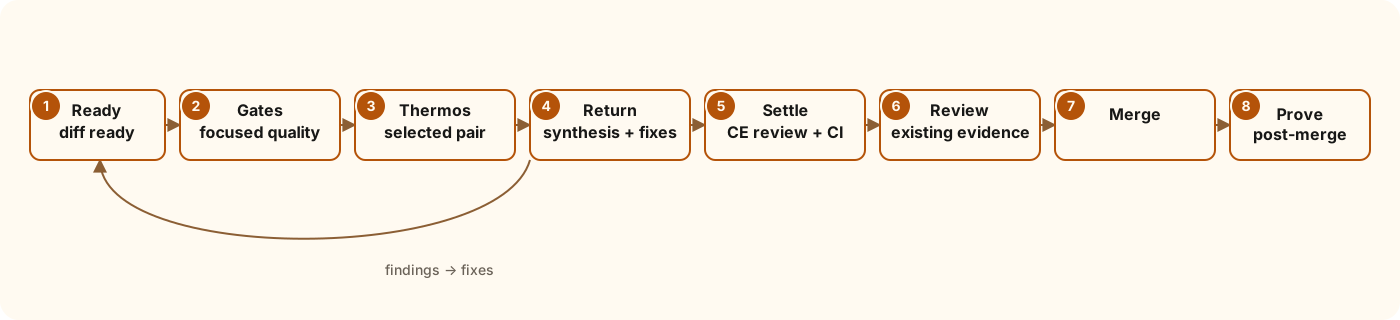
The following review sequence supplies findings to the existing CE owner. Publication requires the completed whole-candidate receipt before any push. Its final review step checks existing evidence; it does not automatically dispatch another reviewer.
Sequence
- Ready. Freeze the complete cumulative candidate and its relevant lifecycle evidence.
- Gates. Keep required and relevant checks tied to the current implementation.
- Thermos. Run both correctness/security and quality lenses alongside Codex review against the same complete candidate.
- Return. Synthesize actionable findings and send fixes to the implementation owner.
- Settle. Bind the review receipt before CE publishes; let CE own feedback resolution, review settlement and CI. Revalidate the complete candidate before each repair push.
- Review. Confirm the current evidence satisfies the repository’s requirements.
- Merge. Merge only within the user’s authorized scope.
- Prove. Verify the merged state and the applicable post-merge result.
UI checks
Use the project’s existing browser and accessibility checks for the changed surface. React Doctor remains available when its analysis is useful for React work. Resolve its current invocation when selecting it; installing or running an additional scanner is not a universal docs, backend, or UI prerequisite.
Dispatch check
A narrow dispatch hook checks native subagent model and effort arguments against the controls the harness supports. Omitting the model means the child inherits. A full-history Codex fork cannot carry model or effort overrides; use a limited-history or no-history fork to change either. Unsupported selections are disclosed; a passing hook test doesn’t show that the live harness ran the selection.
CE merge guard
The merge guard consumes the completed CE owner’s final snapshot, checks that it matches CE’s latest state, and verifies the current PR head and base before a recognized gh merge. Only one hook process runs for each shell call, so the check stays cheap. Missing or stale evidence refuses the merge with a recovery message. CE remains the sole review and CI owner; the guard has no reviewer wait timers or separate watcher.
Deliver supplies the CE snapshot handoff. It requires recent evidence and an explicit head match, and covers the documented shell route rather than arbitrary API clients. The implementation and tests define its checks. Broad prompt nudges and automatic retrospective hooks are retired; cleanup remains manual.
Post-merge proof
When merge is authorized, verify the reported merge commit is reachable from the fetched base branch and run or verify the focused check for the merged result. If the user requested a live deployment, verify the live surface as well.
merge=<reported-merge-commit> ancestry=verified
post_merge_check=<repository-check> exit=0
This is an illustrative receipt shape, not evidence of a live run.