What each control contains, detects, or refuses
Security becomes operational when every hostile path through an unattended fleet ends in an observable outcome: contained scope, a detected condition, a refused change, or a named residual for human judgment. Signed evidence and canary gates make those outcomes durable, so operators can automate confidently while staying precise about the authority facts they still own.
Roundhouse describes security through those outcomes. The operator can see which path an attack takes, which gate stops it, and which residual remains outside the technical model.
Decision path
Action arrives: a stolen key, replayed head, first-contact identity, or hub credential attempts to change fleet state. Authority check: parent-position membership, reviewed-reference ancestry, channel class, and path scope identify what that actor can actually authorize. Propagation gate: review, soak, canary evidence, removal caps, and owner-manager apply bound how far accepted evidence can travel. Outcome: the host contains the action, detects it, refuses it, or journals a named hold. Residual: the page keeps instruction intent, TOFU exposure, offline persistence, privilege ownership, and availability separate from the contained technical outcome.
Trace the underlying decisions through the trust ratchet, canary evidence, anti-rollback, and enrollment walkthroughs. The held marketplace change shows the same path as one worked run.
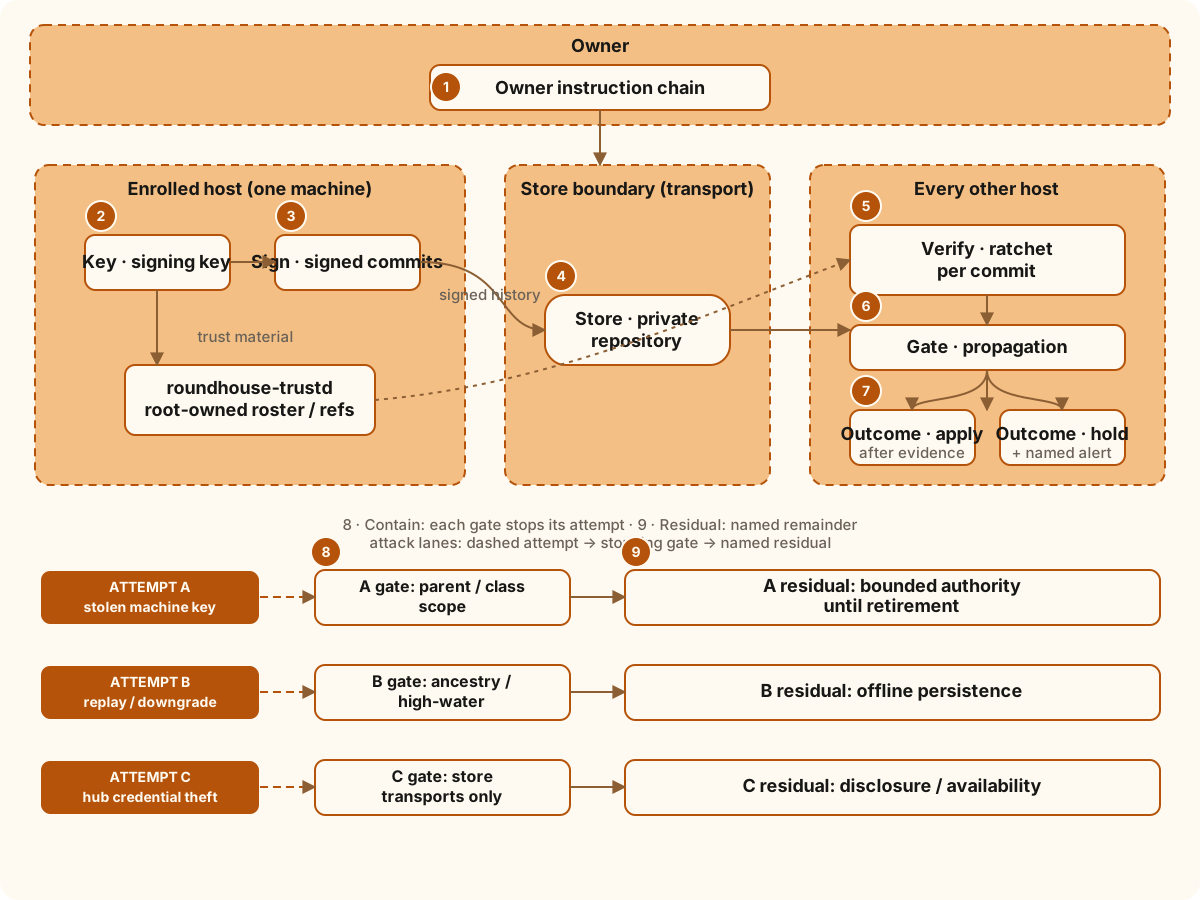
Sequence
- Instruction. The owner chain defines the requested action and its scope.
- Key. An enrolled host holds the machine signing key under its boundary.
- Sign. The host produces signed history that can be checked at the parent position.
- Store. The private repository transports history but never grants authority.
- Verify. Every receiving host applies the trust ratchet to the incoming commit.
- Gate. Scope, soak, canary, ancestry, and manager ownership decide whether propagation may continue.
- Outcome. Good evidence applies; bad or unknown evidence becomes a held, named result.
- Contain. Each attempt meets its own stopping gate: a stolen key at parent/class scope, replay at ancestry/high-water, and hub credential theft at the transport-only store boundary.
- Residual. Bounded authority until retirement, offline persistence, and disclosure/availability remain named residuals alongside instruction-chain compromise and genuine first-contact TOFU.
The boundary map keeps store custody and instruction integrity visible as the two authority facts; the repository transports history but does not authorize it.
Compromised member enrolls an attacker
A compromised member proposes a roster edit for an attacker. Review, held hooks, canary evidence, removal caps, soak, and fleet-wide alerts contain the new authority and surface the attempt. The result is a named roster change for operator action.
Stolen machine key
When one machine key is stolen, the blast radius is one machine’s class and path scope. A one-edit retirement propagates within one fast interval; future commits lose roster membership while prior history remains attributable. The fleet keeps operating while the stolen key is retired.
Replay or downgrade of older history
When older history returns, reviewed-reference ancestry and the monotonic generation mark hold a fetched head that travels backward. A published archive can authorize a legitimate re-root after ordinary ratchet verification; an absent or invalid archive produces hold plus alert. Replay buys persistence for an offline host, never new write entry.
First-contact TOFU MITM
At genuine first contact, a durable enrollment receives a 72-hour soak and a loud, distinct alert class. The real machine does not join while an operator expects one to. An ephemeral runtime-authenticated leaf uses its channel binding and has no first-contact window.
Hub credential theft
If hub credentials are stolen, the hub remains an outer boundary, never the authorization boundary. Every commit still needs a valid signer at its parent position and a permitted class. Credential theft can disclose or reduce availability, but it does not manufacture write authority.
Named residuals
- Instruction-chain compromise has no technical mitigation: containment applies, detection does not.
- TOFU on genuine first contact is structurally open; the soak and alert make that exposure visible and slower.
- A host offline since before a revocation can retain persistence until it reconnects; reviewed-reference checks contain adoption when it returns.
- A same-user-writable roster without a privileged lane or passwordless sudo reduces the model to no effective root boundary.
- Availability is out of scope for authority: controls hold the item and alert the operator until host evidence proves convergence.
Receipt
An operator retiring a stolen key needs a compact answer to five questions: what changed, how far it could reach, how quickly retirement propagated, what future history does, and whether the rest of the fleet continues. The receipt keeps those stakes together:
shape=stolen-machine-key
retirement=commit-signed-and-published
future_commits=held
blast_radius=host-a-only
propagation=one-fast-interval
fleet_availability=continues
The receipt names the control outcome and residual separately, so a contained attack is not reported as a universal prevention claim.