Sync
Delegation works when every machine agrees what an agent is. Declare plugins, skills, MCP servers, hooks, and agent configuration once; converge every enrolled host on the resolved identity; retain evidence of each manager action. An agent can land on any ready machine and find the operating surface the task expects. Roundhouse makes that mechanism concrete, bringing a published skill to each host within one fast interval.
The run
The operator asks for one reviewed skill to become the same usable identity on every enrolled host. Roundhouse publishes the desired item, carries its marketplace SHA and version through the signed store, folds host state, and invokes the native manager that owns the category. The turn is promotion through evidence: canary liveness and hook approval earn downstream apply, while a named hold preserves the prior identity. The run closes when every host journal reports the item as applied, satisfied, or held with the exact reason. See the fleet bring-up that established the operating surface.
The alignment loop
Align the declared category with the native action that can prove it. Desired-state categories map one-to-one onto the manager verbs for Claude and Codex: plugins, skills, agents, hooks, mcp_servers, and config_files. Each item identity carries marketplace SHA plus version, so a re-tagged artifact produces a new decision. Codex hook approval runs again for every plugin install or update; the hooks category stays held until that trust gate clears.
One owned scheduler entry per host runs a fast pass at about 20 minutes with ±5 minutes of host-name-seeded jitter and a full pass at about 12 hours with ±90 minutes of jitter. The name seed spreads the fleet across the window while preserving a stable cadence for each machine.
Operate a personal fleet’s agent toolchain with package-manager discipline: pull-based convergence, canary evidence before a change fans out further, and a signed trust ratchet that raises confidence without standing up a certificate authority. Roundhouse supplies this mechanism.
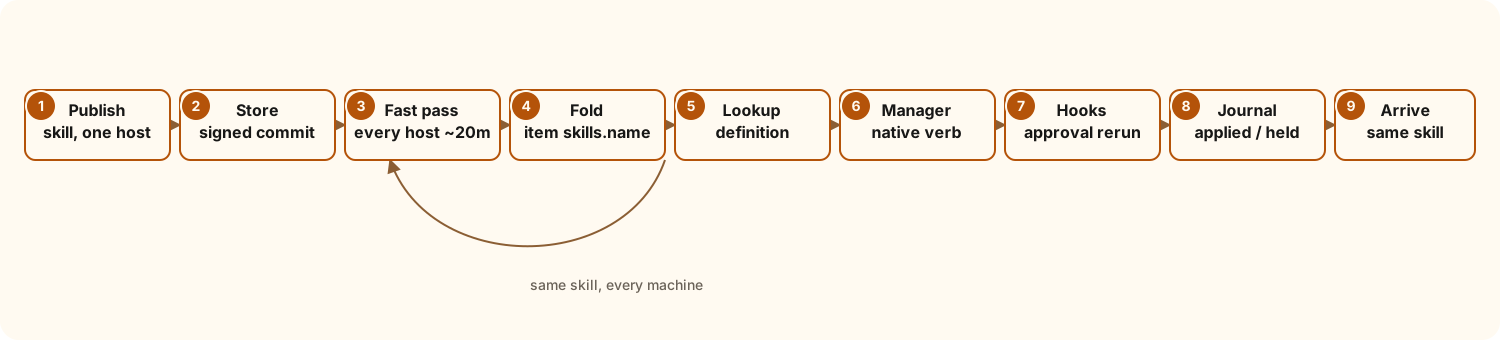
Sequence
- Publish. One host declares the reviewed skill identity.
- Store. Signed history carries the exact item digest to the fleet.
- Fast pass. Every host checks the short path before deeper work.
- Fold. The host resolves the effective
skills.nameitem. - Lookup. The definition identifies the native manager and expected identity.
- Manager. Claude and Codex receive the verb owned by their manager.
- Hooks. Hook approval runs again on install or update.
- Journal. The host records
applied,satisfied, or a named hold. - Arrive. Every host can report the same reviewed skill identity.
The loop’s text fallback is the receipt below: each host records applied or satisfied, and a hook-approval hold preserves the prior applied state.
Worked receipt
item=skills.my-review desired_sha=sha256:7c1a... desired_version=2.4.0
host-a  os=macos  fast=2026-08-13T09:20:14Z  result=applied manager=codex
host-b  os=linux   fast=2026-08-13T09:22:01Z  result=applied manager=claude
host-c  os=wsl     fast=2026-08-13T09:24:33Z  result=satisfied manager=codex
host-d  os=windows fast=2026-08-13T09:25:17Z  result=satisfied manager=claude
Read the receipt as an operational state. applied means the manager changed the item and journaled the exact identity. satisfied means the identity already matched. held names the trust or ownership decision that still needs evidence; it keeps the prior applied state.
Explore the state surface
- State alignment — category, manager verb, identity, and receipt semantics.
- Fleet agents — the skill that owns agent-surface inventory and desired-state sync.
- Roundhouse convergence — the signed pull, gate, apply, and journal loop.
Roundhouse is the existence proof. Its source repository, releases, and review trail carry the public implementation evidence.
For the same operating system from two other angles, follow one request through delivery or one host through convergence.