History moves forward, including after a re-root
Every host in an unattended fleet needs a durable memory of the newest trusted position, so signed evidence and canary results continue to govern current intent. Forward-only adoption keeps autonomous recovery useful and turns a downgrade attempt into a visible operator decision.
Roundhouse gives each privileged host two monotonic high-water marks: generation never decreases, and every adopted head descends from reviewed-ref. A fetched head that violates either mark is held and alerted before it can become desired state.
Decision path
Action arrives: a host fetches a signed head that proposes the next desired-state position. Authority check: signed history must still connect to the host’s reviewed reference. Propagation gate: ancestry and the monotonic generation mark advance together; a legitimate re-root also supplies the published archive that contains the prior reference. Outcome: the host records result: adopted, or preserves reviewed state with result: held and alert: anti-rollback. Residual: an operator still authorizes genuine history migration by publishing and retaining the archive evidence.
Adoption decision
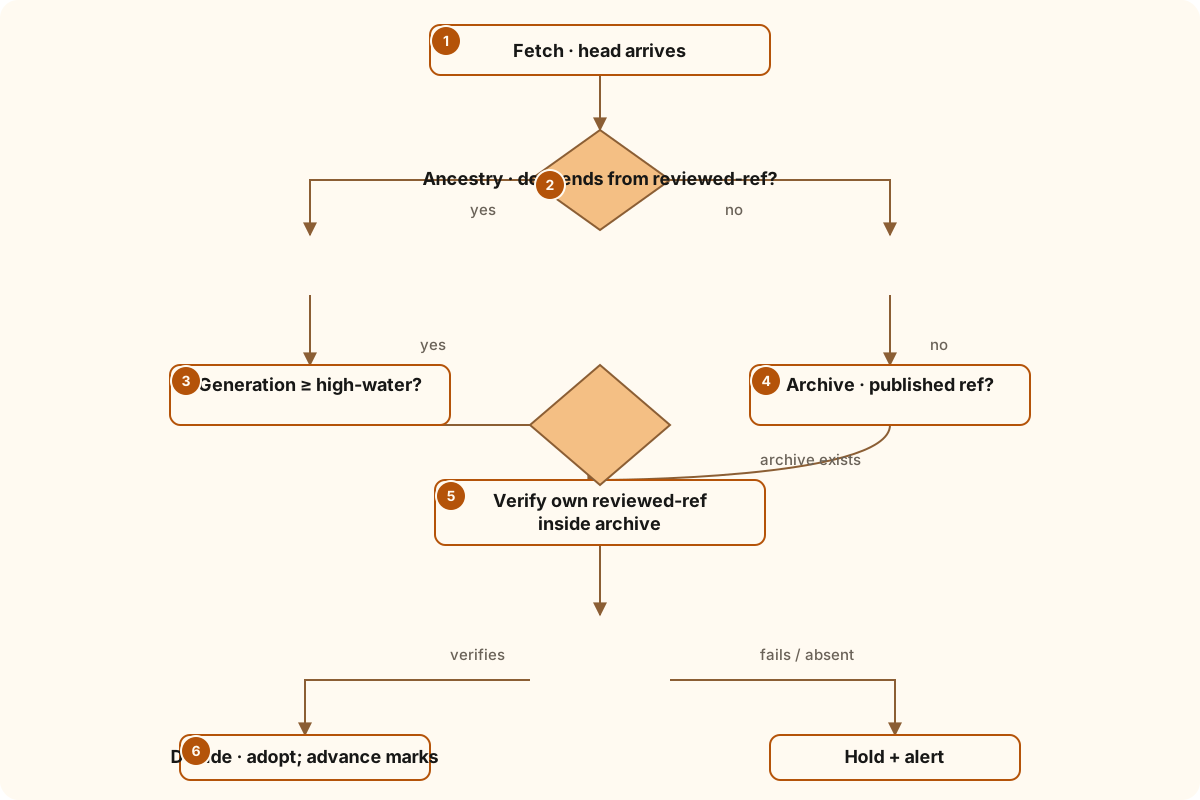
Sequence
- Fetch. The host receives a signed head that proposes the next state.
- Ancestry. It checks whether the head descends from the reviewed reference.
- Generation. A descendant must meet the monotonic high-water mark.
- Archive. A re-root must name a published archive reference containing the prior reviewed reference.
- Verify. The host checks that archived reference with the ordinary trust ratchet.
- Decide. A valid path adopts and advances marks; a failed or missing proof holds and alerts with
anti-rollback.
Read the diagram as the operator’s recovery decision: a missing archive is itself a hold plus alert, which is the rollback protection.
The checkpoint re-root protocol keeps a legitimate history migration byte-for-byte indistinguishable from a rollback attack except for one mandatory published archive ref. A host that was offline across the re-root verifies its own reviewed reference inside that archive using the ordinary trust ratchet. An absent archive produces hold plus alert; that refusal is the protection.
Receipt
After a routine fetch, the host can show that generation 18 descends from its reviewed reference and was adopted:
reviewed_ref: main@change-2f4a
fetched_head: main@change-2f4a
generation: 18
high_water_generation: 18
descends_from_reviewed_ref: true
result: adoptedreviewed_ref: main@change-1a00
fetched_head: main@change-0f00
generation: 17
high_water_generation: 18
archive_ref: absent
result: held
alert: anti-rollbackIn the higher-stakes case, an anonymized host sees generation 17 after it has already trusted generation 18. An absent archive leaves the re-root unauthorized, so the host preserves the reviewed state and raises anti-rollback.
Recovery completes
Recovery does not lower either high-water mark. fleet-checkpoint publishes its ordinary signed commit as refs/tags/rh-checkpoint-<epoch> and refs/roundhouse/archive/YYYYMMDD. Before re-rooting, fleet-reroot refreshes origin and atomically republishes that archive ref; it refuses unless fetched main@origin and this host’s resolvable reviewed-ref are covered by the checkpoint, or if local main has advanced beyond it. On reconnect, the host finds its reviewed reference in the archive, replays the ordinary ratchet through the checkpoint, checks that the checkpoint generation is at least 18, verifies the new root against the checkpoint roster, and only then advances root-owned reviewed-ref to the new root.
checkpoint_tag=refs/tags/rh-checkpoint-<epoch>
archive_ref=refs/roundhouse/archive/YYYYMMDD
recovery reviewed-ref=advanced-to-new-root generation>=18
doctor head-signature=ok ratchet-replay=ok monotonicity=ok
doctor checkpoint-tags=ok archive-present=ok exit=0
The outcome is a clean doctor and a restored reviewed line without weakening the refusal that exposed the missing proof. The archive remains the residual evidence to retain. For the same hold → evidence → release arc at the item layer, read The change that waited for evidence.
The mark is root-owned where the privileged lane exists. The store’s ordinary signed history remains the source of the reviewed reference.