Let evidence earn the next host
Let one host in an unattended fleet prove the exact signed digest under real operation, require that evidence to age, and confirm the canary is still speaking before widening the rollout. This turns fleet velocity into a paced, observable decision with a bounded blast radius.
For each item, a downstream host applies the exact digest only after the canary result has aged through the configured wait, stayed free of a later hold or revert, and remained live by publishing a later record.
Decision path
Action arrives: a downstream host sees a desired item at an exact signed digest. Authority check: the item identity and signed store history establish what is being proposed. Propagation gate: the canary’s applied or satisfied result must age through the configured 24-hour default wait, remain free of a later hold or revert, and gain a later liveness record. Outcome: the same digest applies, or the host records result=held reason=canary-silent and keeps its prior value. Residual: canary unavailability can pause rollout, making availability an explicit operator concern rather than an implicit authorization.
Follow the held marketplace change and its recovery evidence.
The liveness term
For item X at digest D, the downstream gate earns promotion through four checks:
- canary journaled
appliedorsatisfiedfor D att0; t0is at least the configuredcanary_wait_hoursold, with a 24-hour default and fallback;- no later
heldorrevertedrecord covers D; - the canary published any record after
t0 + canary_wait_hours.
The last condition closes the silenced-canary case. A canary that stops publishing cannot silently authorize further spread. satisfied counts because the desired identity is still observed; held carries a refusal and keeps the prior applied value.
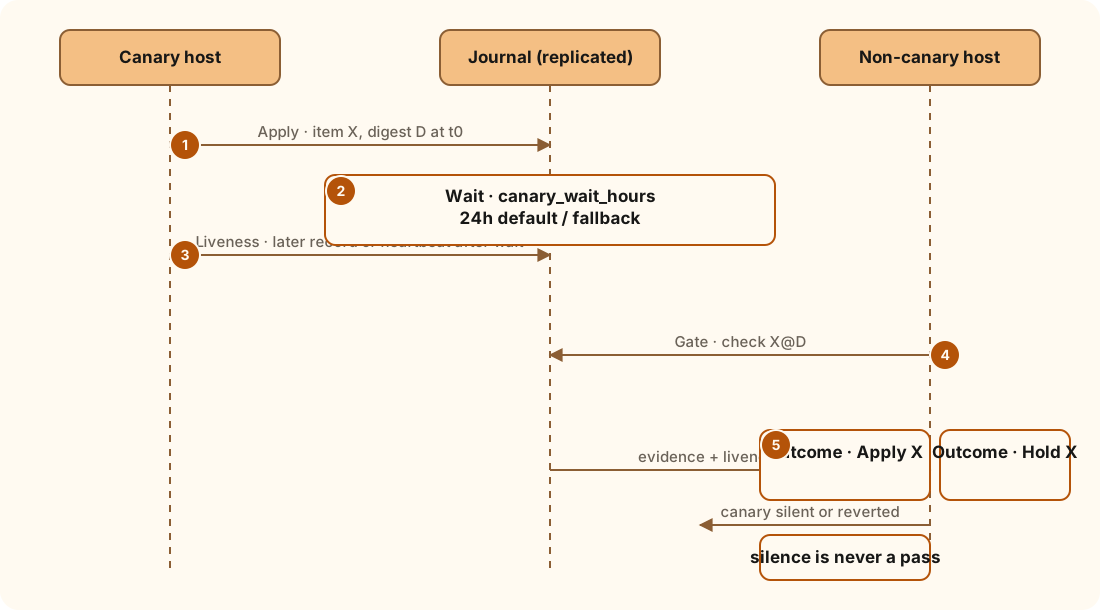
Sequence
- Apply. The canary records the exact item digest at
t0. - Wait. The digest ages through the configured
canary_wait_hours, with the 24-hour default/fallback. - Liveness. The canary publishes a later record or heartbeat after the wait.
- Gate. A downstream host checks the digest, age, later holds/reverts, and liveness.
- Outcome. Evidence and liveness authorize the same digest; silence or reversion records
held reason=canary-silent.
The sequence keeps silence explicit: evidence without a later record or alive heartbeat is a hold, never a pass.
The wait plus the per-run removal cap bounds blast radius. An operator sees a named hold before another host applies the affected item.
Receipt
In the successful story, canary-1 applies the review skill, stays healthy through the configured 24-hour default window, and publishes again; only then does host-a apply the same digest:
canary-1 item=skills.my-review digest=sha256:7c1a... result=applied at=t0
gate wait=24h(default/fallback) later_hold=none later_revert=none liveness=published
host-a item=skills.my-review digest=sha256:7c1a... result=applied
canary-1 item=hooks.review-gate digest=sha256:12af... result=applied at=t0
gate wait=24h(default/fallback) later_hold=none later_revert=none liveness=silent
host-a item=hooks.review-gate digest=sha256:12af... result=held reason=canary-silentIn the second story, the canary goes silent after applying a review hook. The downstream host preserves its current state and records canary-silent, making missing liveness an actionable result.